By Dr. Peter West-Oram
As a participant at the St. Hilda’s Workshop in 2024 which explored ways of incorporating solidarity and collective action “to advance a more just global health framework”, I was delighted to be invited to comment on the draft principles for embedding solidarity in the global health ecosystem.
My own work on solidarity in global health is grounded on the principle that solidarity is foundational to justice, and to successful global (and domestic) health practice. Yet, affirming solidarity also requires attention to the conditions that undermine it. As noted by Marlise Ritcher, in a context where many global structures are seemingly designed to exclude from the group of solidaristic concern billions of people worldwide, achieving solidarity for global health can seem elusive at best. 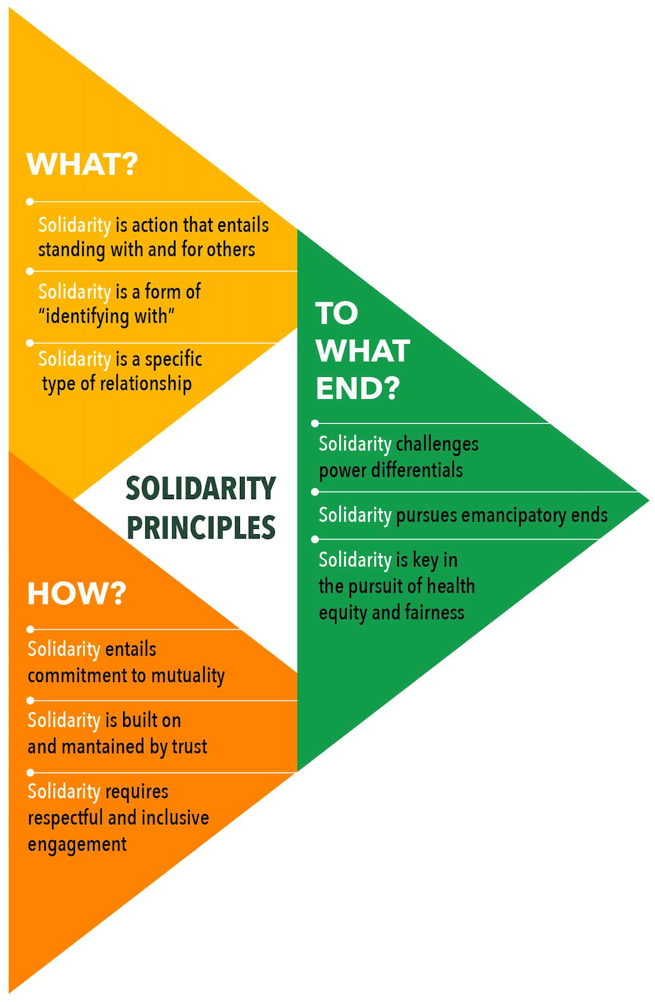
In this context, the principles (Pg 15 here) provide a clear and compelling explanation not only of what solidarity is, but also what it can and should do, and how we should go about engaging in it.
Principles one, two and three “The WHAT” affirm that solidarity is not merely something that we express in sympathy to the vulnerability of others, nor is it simply an emotion we feel. Rather, “solidarity is enacted, not merely proclaimed” – to engage in solidarity therefore is to act, including “carrying costs” as Barbara Prainsack and Alena Buyx put it, for those with whom we identify. Importantly, when faced with the challenges of global health, and the at times seemingly insurmountable barriers to global health justice, the solidarity that is needed must move “Beyond Symbolic Acts” to a deep and lasting commitment to the pursuit of ongoing collaborative justice.
This framing continues through principles four, five and six “The HOW” which collectively state that any commitments to carry costs must be grounded in mutuality, trust and respect, a recognition that the solidarity relationship is not transactional, and that engagement in solidarity allows for disagreement, while maintaining recognition of the validity of differences in experience and capacity. In doing so, this second triad, “How,” affirms the fundamentally egalitarian and non-hierarchical nature of solidarity, distinguishing it from charitable action, and grounding it in recognition of similarities with other people and shared interests in common goals.
Finally, the third Triad, “To WHAT END” explores the goals of solidarity in global health. These are perhaps the most important, since engaging in solidarity, requires clarity about what we are seeking to achieve. The framing in principles seven, eight and nine affirm that solidarity challenges inequality, “pursues emancipatory ends”, and is central to the “pursuit of health equity and fairness”. It is here that I would raise a question about this framing; solidarity is essential to these goals and can certainly advance them. However, it is worth considering the extent to which solidarity is also used in pursuit of less admirable objectives, in a narrower fashion than is necessary for meaningful progress in global health, and/or in a manner which may even be exclusionary and harmful. For example, while solidarity was enacted to an extent at the global level during the COVID-19 pandemic, wealthy countries stockpiled vaccines in order to protect their own populations, reducing access for poorer nations.
This hoarding might arguably be seen as a form of exclusionary solidarity, engaged in with some people but not others. I am not suggesting that as an action of solidarity, the hoarding of vaccines is therefore a good thing, but rather that it is also useful to acknowledge that solidarity can be used for harmful or ignoble ends that do not align with the emancipatory and cosmopolitan egalitarian framing suggested in principles eight and nine. As noted on an earlier blog by Francisco Mendina, solidarity is “far from a neutral concept” – people can and do engage in solidaristic actions which are actively harmful to those with whom the relevant parties do not engage in solidarity.
Recognising this, I suggest is helpful as it provides us with the language to challenge, and ideally overturn the exclusionary, and hostile uses of solidarity which we should rightly not wish to endorse.
Dr. Peter West-Oram is an Associate Professor of Bioethics at Brighton and Sussex Medical School, University of Sussex, and the author of ‘Justice, Solidarity, and Global Health: From Globalisation to Collaboration.’ Read his book here: https://www.routledge.com/Justice-Solidarity-and-Global-Health-From-Globalisation-to-Collaboration/West-Oram/p/book/9781032571782