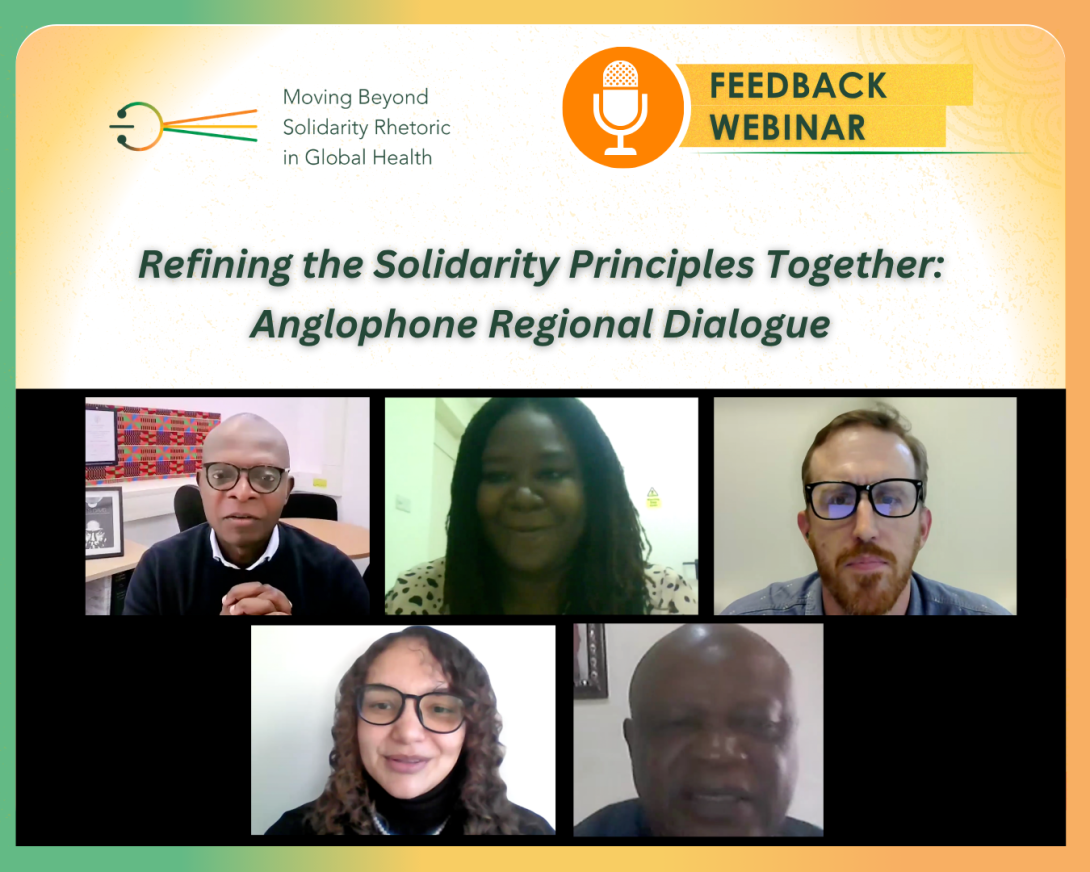
The Global Health Solidarity Project has launched its Regional Feedback Webinar Series, themed “Refining the Solidarity Principles Together”. The webinar brought together speakers and participants from the earlier Anglophone workshops that shaped the draft Principles for Embedding Solidarity in the Global Health Ecosystem. These included academics, researchers, bioethicists, public health experts, civil society organisations, activists, practitioners and community representatives from the Global Health Justice Group gathering, the Rural Women’s Assembly workshop, the Expert Workshop on Igbo Conceptualisations of Solidarity, and the Anglophone Africa workshop held in Ghana.
The session gave participants/contributors an opportunity to see how their input had shaped the document, and weigh in on its strengths and gaps.
Project lead Professor Caesar Atuire opened the session by framing the feedback process as a matter of obligation to the communities who helped build the principles. Returning the draft for scrutiny, he said, was a way of checking that the project was on the right track.
The draft principles were then introduced by Dr. Zaida Orth, Postdoctoral Researcher with the project at the University of Cape Town, who presented the 3–3–3 framework: what solidarity is, how it is enacted, and the ends it should pursue. Her presentation situated the principles within real global health challenges, including unequal power relations, funding shifts, shrinking civic space, and the urgent need to move solidarity beyond language.
“Experience has shown me that solidarity is not optional. We have seen what is possible when we all stand together — from African support during apartheid to collective action for HIV treatment access.”
Across the discussion, several speakers broadly affirmed that the principles captured important dimensions of solidarity raised through the project’s earlier workshops and dialogues.
Dr. Peter West-Oram, Associate Professor of Bioethics at Brighton and Sussex Medical School, University of Sussex, reflected on the clarity and usefulness of the framework. Representing the Global Health Justice Group gathering held at the University of Oxford, he noted that the principles helped articulate both the moral and practical importance of solidarity in global health.
“Reading the principles was a wonderful experience. It is rare to encounter something that explains what you think better than you think it yourself…. Solidarity functions to facilitate the fulfillment of our duties to others. It is the glue that makes justice possible and the practice of global health meaningful.”
Professor Francis Njoku, Professor of Philosophy and Jurisprudence at the University of Nigeria, Nsukka, representing the Expert Workshop on Igbo Conceptualisations of Solidarity, also affirmed the principles while deepening their philosophical grounding. Drawing on Igbo and African understandings of personhood, he argued that solidarity is rooted in human interdependence and complementarity.
“Solidarity entails relating and identifying with others, but it is rooted in a metaphysics of human nature. The principles reflect this truth — that none of us is sufficient alone, and our survival depends on leaning into each other’s spaces.”
While the principles were strongly affirmed, the webinar also generated constructive feedback that will be central to the next phase of the project. Speakers challenged the project to ensure that the framework remains grounded in lived realities, cultural understandings, methodology, and practical application.
Dr Suzall Timm, Lecturer in Development Studies in the Department of Anthropology and Development Studies at the University of Johannesburg, drew on the Rural Women’s Assembly workshop to offer a reflective critique of the principles. She encouraged the project to consider not only what the principles express, but also what they make visible, what they may leave out, and how they can better reflect the lived and embodied practices of solidarity. Her contribution highlighted the importance of bringing the normative framework into closer conversation with descriptive and methodological approaches, so that the principles remain grounded in real experiences rather than becoming abstract or prescriptive.
Professor Bonaventure Nwokeoma, from the Department of Sociology and Anthropology at the University of Nigeria, Nsukka, reflected on the principles through Igbo understandings of kinship, community, and identification with others. He noted that solidarity is deeply embedded in culture and extends through networks of family, community, and belonging, including among those in the diaspora who remain connected to home. While affirming that the principles capture this spirit, he emphasised that their next test will be practical: ensuring that they can be translated into concrete solidaristic practices within the global health funding ecosystem, in ways that challenge structural inequalities rather than reproduce them.
Building on the practical lens of the draft principles, Dr. Irene Honam Tsey, Research Fellow at the Centre for Health Policy and Implementation Research, Institute of Health Research, University of Health and Allied Sciences, Ghana, reflected on how the framework captures key discussions from the Ghana workshop, particularly the understanding that solidarity is not charity, nor sympathy without sacrifice. She emphasised the importance of action, sustained relationships, respectful and inclusive engagement, and the need to value community knowledge by involving communities in shaping decisions, rather than simply asking them to respond to decisions already made.
Responding to the call for practical application, Professor Atuire emphasised that the next stage of the project is precisely to move from principles to tools that can guide different actors across the global health funding ecosystem.
“If we don’t get this right, then the actions that will follow will also be off. That is why we must refine these principles together now, so they can move beyond theory into actionable tools that embed solidarity meaningfully in the global health funding ecosystem.”
The webinar therefore affirmed the value of the draft principles while sharpening the questions that must guide their next phase. Speakers welcomed the framework, but also challenged the project to ensure that it remains accountable to the communities that shaped it, attentive to lived realities, and capable of guiding practical action.
As the Global Health Solidarity Project continues its Regional Feedback Webinar Series, these conversations will help inform the development of practical tools and solutions for embedding solidarity in global health research, funding, partnerships, policy, and implementation.
The project extends its sincere thanks to all speakers, participants, and attendees who contributed to the Anglophone Regional Dialogue.
Watch the Feedback Anglophone Webinar Here: https://www.youtube.com/watch?v=PAtskddbpYc
The Next Feedback Webinar:
Event: Pacific and South Asia Feedback Webinar on the Solidarity Principles
Date: Wednesday, 5th August 2026
Time: 2:30 PM AEST | 4:30 PM NZST/FJT | 10:00 AM IST | 5:30 AM BST | 4:30 AM GMT | 6:30 AM CEST | 7:30 AM EAT
Format: Virtual
- Log in to post comments