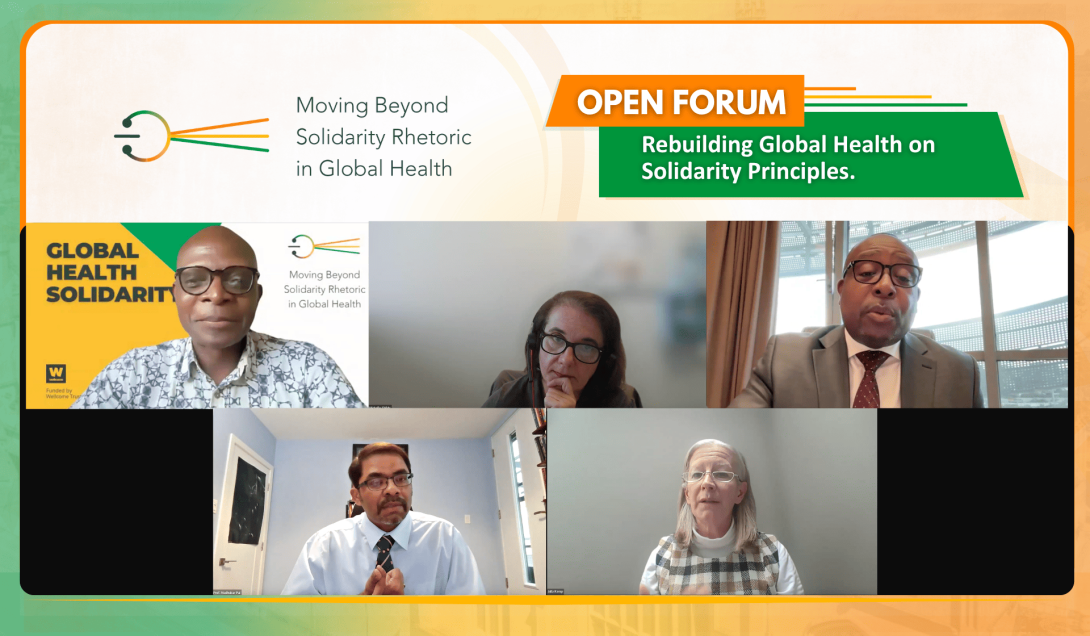
What does solidarity actually demand of global health when the system itself is under strain? This question gave the Global Health Solidarity Project’s 2026 Open Forum its urgency, its edge, and its relevance. Held under the theme “Rebuilding Global Health on Solidarity Principles,” the event treated solidarity as a test for institutions, funders, researchers, and global health actors at a time when funding cuts, political fragmentation, and weakened multilateralism are exposing just how fragile collective commitments can be.
Moderating the session, Prof. Atuire (GH-Solidarity project), emphasised that if solidarity is going to matter, it cannot remain rhetorical. It must begin to shape the very systems through which global health is financed, governed, and practised. The Open Forum marked the first public presentation and dialogue of the draft Solidarity Principles, a framework shaped through regional workshops, stakeholder interviews, project dialogues, and a major convivial workshop convened in Johannesburg in February 2026.
What we are presenting today is a 3‑3‑3 framework that asks three simple but profound questions: What is solidarity? How is it practiced? And to what end? These principles help us move from aspiration to action, from sentiment to structure."
The first speaker, Michelle Childs (DNDi), drew a clear distinction between values that sound good and practices that hold when conditions become difficult. Her warning was especially striking for its uncompromising clarity: “Rhetorical solidarity is cheap, Operational solidarity is hard.”
"For me, the question is not whether solidarity is a nice idea — it is whether we can design systems that hold on to justice when it is inconvenient, when funding tightens, and when politics intrude. Solidarity helps us decide what we do not compromise on when things get tough."
For Michelle, that means treating knowledge and health tools as shared goods rather than assets to be withheld, traded, or leveraged. It also means shifting attention away from institutional self-preservation and back towards the problem to be solved, the people affected, and the partnerships required to respond well. In her account, solidarity is something built through shared authority, accountability, and structures that can withstand pressure.
Prof. Madhukar Pai, (McGill University, Canada), raised the moral and political temperature of the discussion. He spoke with striking bluntness about the failures of the current moment: vaccine inequity, war, collapsing aid, climate injustice, and the widening gap between the language of solidarity and the conduct of powerful states. His point was that much of what the world is currently witnessing is the opposite of solidarity.
"Global health has always been unequal, but the pandemic made those inequalities impossible to ignore. If solidarity is to mean anything, it must confront the systems that reproduce injustice — not simply respond to crises when they explode."
And yet, even within that bleak diagnosis, he insisted on the need to begin from reality rather than consolation. From there, he pointed towards a more hopeful horizon: one in which Global South leadership, self-reliance, and South–South solidarity become central, not peripheral, to the future of global health.
Julia Kemp (Wellcome Trust), offered a grounded account of how Wellcome, a major philanthropic actor, is trying to work through questions of equity, partnership, and responsibility. Her remarks translated solidarity into the quieter but decisive questions that shape research ecosystems: who leads the science, who is able to participate, and who ultimately benefits from it. Julia reflected on the limits of scale, the importance of funding knowledge and institutions rather than only projects, and the need to locate decision-making closer to the contexts in which impact is meant to happen.
"If we want solidarity to be real, we must build research ecosystems where communities are not peripheral but central. Equity is not a by‑product of good intentions — it is the result of deliberate design."
Dr Benjamin Djoudalbaye (Africa CDC), brought the discussion back to implementation. His contribution linked the language of solidarity to the practical demands of regional public health coordination. He emphasised that solidarity is not charity, nor can it be treated as an optional add-on in times of crisis. It requires shared responsibility, trust, transparency, voice, and agency. Most importantly, he argued that the real test lies in whether principles are translated into governance, financing, and accountability mechanisms that endure.
"Africa has shown again and again that solidarity is not abstract — it is lived. But global solidarity must match that commitment by ensuring that African institutions have the power, resources, and voice to act."
Speaking from Africa CDC’s perspective, he pointed to concrete areas of work: pooled procurement, regional manufacturing, and stronger continental systems for data and coordination, as examples of what operationalising solidarity can begin to look like. His closing argument was clear: if solidarity is to shape the future of global health, it has to be embedded in the architecture of systems, not patched on when emergencies arrive.
Taken together, the forum painted a clearer picture of what solidarity begins to demand when it is taken seriously. Across the different perspectives, several themes kept resurfacing:
- Solidarity as action rather than declaration
- Solidarity as inseparable from power, participation, and institutional design
- Solidarity as requiring structures robust enough to withstand funding pressures and political strain
- Solidarity as something that must be built before crisis, not merely invoked during it
These concerns echo the wider reasoning behind the draft Principles themselves, which were developed precisely because prevailing invocations of solidarity in global health have too often remained aspirational, vague, or detached from practice.
Watch the Open Forum Here: https://www.youtube.com/watch?v=jZoGqP-MyPQ
You can find the Solidarity Principles on page 15 of the Convivial Solidarity Workshop Report here:Convivial Solidarity Workshop Report
- Log in to post comments