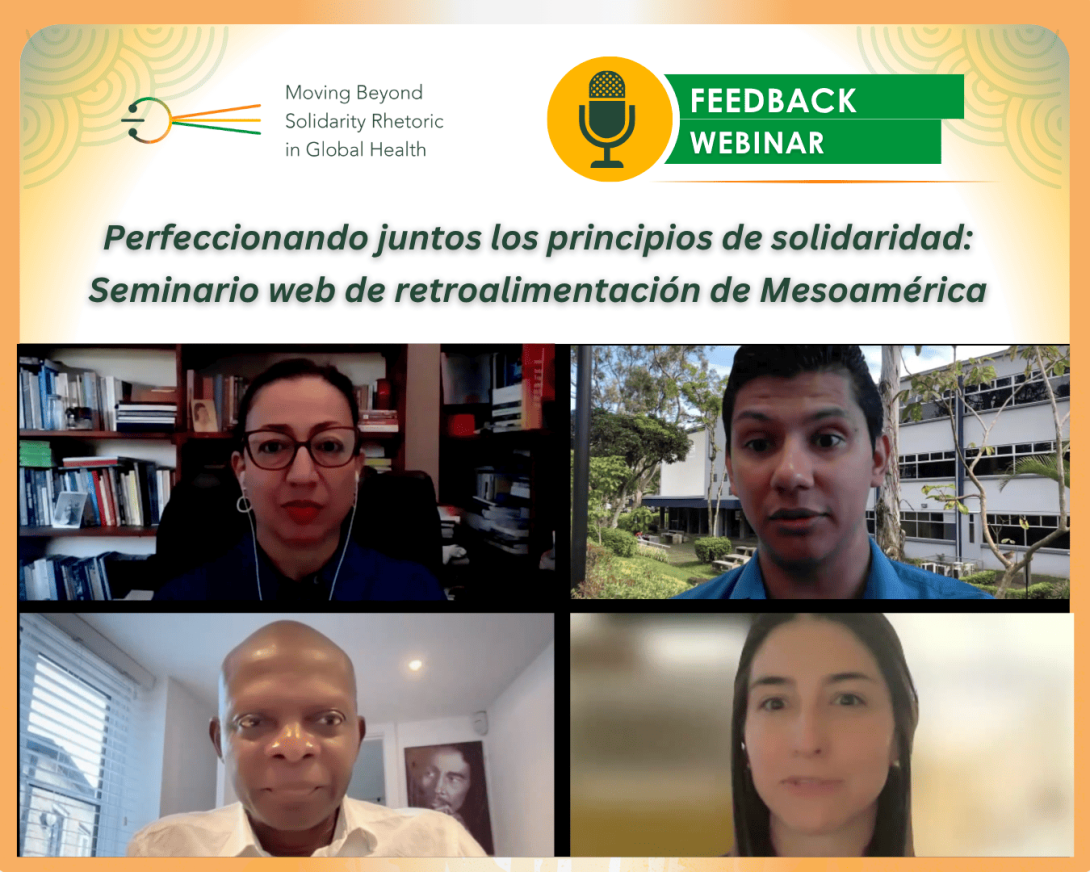
The Global Health Solidarity Project continued its Regional Feedback Webinar Series,“Refining the Solidarity Principles Together,” with a dialogue bringing together participants from across Mesoamerica and Latin America to reflect on the draft Principles for Embedding Solidarity in the Global Health Ecosystem. Drawing on experiences from public health, global health education, policymaking and Indigenous leadership, participants challenged the project to deepen its understanding of solidarity as a long-term practice grounded in relationships, power-sharing and structural change.
Opening the webinar, Prof. Gabriela Arguedas-Ramírez, Co-Investigator on the Global Health Solidarity Project, reflected on how the project emerged in the aftermath of COVID-19, when calls for solidarity were widespread but often failed to translate into action. She noted that the project seeks to move beyond rhetoric by developing principles and practical tools that can help embed solidarity across the global health ecosystem.
Participants welcomed the draft framework while also urging the project to confront the realities that continue to undermine solidarity in practice, including unequal power relations, shrinking international cooperation and increasingly transactional approaches to global health.
Among the strongest themes to emerge was the importance of time in building solidarity.
Reflecting on his experience in collaborative health initiatives, Dr. Jean Carlo Segura Aparicio Professor of Medicine at the University of Costa Rica and the University of Toronto, argued that solidarity cannot be reduced to a set of short-term interventions.
“Mutuality, trust and sustained relationships require time. They are not something that can be achieved in minutes or seconds.”
He also challenged participants to think beyond charitable notions of helping others, emphasising the importance of recognising the equal value of diverse forms of knowledge and experience.
“What a community leader, social actor or local organisation contributes is equal in value to what I contribute, regardless of my academic, economic or social position.”
Building on this theme, Carolina Bolaños, M. Sc. a Program Director with Child Family Health International, reflected on lessons from global health education and international partnerships. She highlighted the shift away from short-term “mission trips” toward approaches that centre learning, ethical engagement and long-term relationships.
“We cannot transform global health practice without also transforming how we educate the people who will go on to practise global health.”
Bolaños also encouraged the project to place questions of power more explicitly at the centre of the framework.
“If we move solidarity from aspiration to practice, we have to keep asking: who defines the problem, who participates, who controls resources, and who decides what success looks like?”
The webinar also featured written reflections from Dr. María Luisa Ávila, former Minister of Health of Costa Rica and internationally recognised paediatric infectious disease specialist. Her comments reinforced a distinction that surfaced repeatedly throughout the discussion: solidarity is not charity.
“Solidarity is not charity. Nor is it a situation where some decide what others need, set priorities, control resources, and then call the result cooperation.”
She argued that meaningful solidarity requires institutions to share decision-making power, recognise local knowledge and remain committed beyond moments of crisis.
Participants from across the region further expanded the conversation by drawing attention to Indigenous knowledge systems, collective care practices and community-led responses to health crises.
In his closing reflections, Prof. Caesar Atuire, Principal Investigator of the Global Health Solidarity Project, noted that the discussion had surfaced an important challenge for global health: building solidarity within systems organised around short-term projects and funding cycles.
“When you begin something, you are beginning a relationship. A relationship is a living thing, and you cannot simply end it when the project ends.”
He emphasised that the project’s next phase will focus on translating the principles into practical tools and metrics that can help organisations assess and strengthen solidarity in their own contexts.
The Global Health Solidarity Project extends its sincere thanks to all participants who contributed their insights and experiences. The reflections shared during the Mesoamerica webinar will help shape the further refinement of the draft principles and support the development of practical resources for embedding solidarity more meaningfully across the global health ecosystem.
“If we refine these principles together now, they can move beyond theory into actionable tools that embed solidarity meaningfully in the global health funding ecosystem.” — Prof. Caesar Atuire
Watch the full Webinar in Spanish with English subtitles here: https://www.youtube.com/watch?v=CFV_oEMecOI
- Log in to post comments