
Author: Paul Ongboche, PhD Candidate, Health & Rehabilitation Science, Western University
I attended the 32nd Canadian Conference on Global Health (CCGH) in Montréal, from 15 to 18 October 2026, as a PhD candidate contributing to the Global Health Solidarity Project, a Wellcome Trust-funded collaboration exploring what solidarity means in global health and how to move it beyond rhetoric. The conference theme, “Collectively reclaiming global health equity: Restoring commitment to action in a fragmented and uncertain world”, closely mirrored our own questions.
The project’s 3-3-3 Solidarity Framework (Atuire et al., 2026) draws on conversations and materials analysed since 2024 by the project team and outlines criteria for identifying solidarity in Global Health work. It brings together nine draft articles organised into three interconnected triads. The first, “What Solidarity is”, examines what constitutes solidarity (Articles 1 to 3); the second, “How Solidarity is Enacted”, considers how solidarity should be practised (Articles 4 to 6); and the third, “To What End”, addresses what solidarity should ultimately achieve in global health (Articles 7 to 9).
Together, these three triads provide a way to examine not only whether solidarity is present, but also how it is expressed and what difference it makes.
I took this framework to Montréal and found solidarity everywhere, but mostly under other names: equity, community voice, partnership, alignment, resilience or accountability. This post reads the sessions I attended through the three triad questions, then asks a fourth: what goes missing when solidarity travels under those other names?
Triad 1: What is solidarity? Heard as equity and voice
The first plenary I attended, Inspiring Action for Health Equity, was a circular, bilingual fireside conversation. The panel argued that equity must run through the design, implementation and evaluation of health initiatives, shaped by those most affected. Aligned with norms for decolonised practice in GH, this also aligns to how our project understands what solidarity is: action that stands with and for others (Article 1), rather than a goodwill gesture handed down from above.
Oral Session 12, Frontline Providers and Equitable Maternal and Newborn Health, pushed the question further by putting frontline providers at the centre. One Burkina Faso study, “Whose Quality Counts?”, centred women's own voices in how the quality of care is measured. The same question applies to solidarity: whose definition counts? It is why our project takes a pluriversal approach, gathering many understandings of solidarity, especially from people rarely heard, rather than imposing one. The sessions I attended spoke most directly to Article 1, solidarity as action.
Triad 2: How is Solidarity enacted? Experienced as alignment and endurance
Plenary 3, Aligning Funding, Evidence, and Strategies to Galvanize Global Health Action, spoke to how solidarity is tested in practice. The session argued that change requires alignment between four groups: communities, evidence producers, implementers and funders. That alignment is where solidarity succeeds or fails. The two-way arrows in Figure 1 shows that mutuality, trust and inclusion have to run in both directions between each pair of groups, not only from funders downward. This is not to claim that the plenary answered every article in the framework but it links to the Triad 2 articles on mutuality (Article 4), trust (Article 5) and respectful and inclusive engagement (Article 6), and leave the other articles unaddressed.
Figure 1
The Four-Way Alignment Discussed in Plenary 3
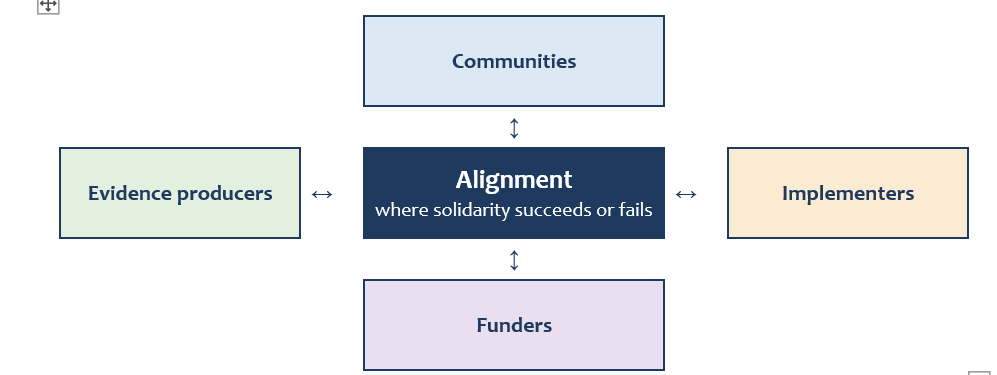
Note. Adapted from CCGH 2026 Plenary 3, Aligning Funding, Evidence, and Strategies to Galvanize Global Health Action.
Oral Session 12 showed what that alignment looks like on the ground. Village midwives sustained reproductive health care in insecure regions of Burkina Faso, and community midwives acted as system connectors across Pakistan’s stable and crisis settings. The solidarity lesson was about endurance. These providers keep services running between projects and through crises, so solidarity means supporting them beyond project life cycles, not only in emergencies.
The simulation activity “Centering Communities in Crisis: A Rapid Response Simulation on Climate & Health” put solidarity under pressure. Over 90 minutes, teams faced a fast-moving, climate-driven zoonotic outbreak. The time pressure changed how we worked: decisions drew on whatever evidence was ready to hand, and communities were easy to consult late or not at all. Solidarity articles such as “respectful and inclusive engagement” (Article 6) have to be considered during emergencies, so that communities are partners in the response, not recipients of it.
Triad 3: To what end? Counted in money and access
According to the 3-3-3 Solidarity Framework, solidarity should serve to achieve health equity, fairness and justice (Atuire et al., 2026). Oral Session 27, Financing Health Systems for Equity, made those ends concrete: financing should be judged on who it protects, not only on how much it mobilises (Article 9). As external aid contracts, domestic financing choices increasingly decide who is covered.
Two digital health sessions, Oral Sessions 18 and 23, showed that digital tools can widen gaps as easily as they close them, depending on who designs, uses and governs them. Who designs, owns and governs digital health is therefore a solidarity question about who holds power over decisions and governance (Article 7).
The Fourth Question: Where solidarity was misread
Hearing solidarity under other names has a cost; each name can stand in for only part of it. What follows is my own reading, not a claim any presenter made.
- As crisis response, the simulation showed how quickly solidarity articles such as “respectful and inclusive engagement” (Article 6) in this case are neglected during a public health emergency.
- As consultation, community voice ran through Plenary 2 and the oral sessions. Consultation at one stage can pass for participation when the questions and the measures are set elsewhere.
- As money mobilised, financing is where solidarity gets counted, and it can be counted the wrong way. The figure for funds raised says little about who is protected and on whose terms, a gap that matters more as external aid contracts.
- As access to tools, in the digital health sessions, access was not the same as benefit. Tools may reach those already best served, unless context-specific existing inequities in access are taken into account, and the people they are meant for actively contributes to the design, ownership and governance of these tools.
- As a word, the conference theme asked for restoring commitment to action, which concedes a gap between what global health forums say and what they do. In my reading, a forum can speak fluently about equity, partnership and community without changing who decides.
None of this means the word itself is needed. It means that when solidarity travels under other names, someone must ask what each name leaves out.
Capacity building as solidarity
I attended as a junior scholar, and that shaped how I heard all three questions and provided me with an opportunity to ask mine. Attending CCGH gave me training and access to the rooms where agendas are discussed, the people whose work shapes the field, and the shared vocabulary that lets a junior scholar contribute rather than only observe.
That matters because global health research remains shaped by asymmetries in funding, authorship, data ownership and priority-setting. Opening doors early to the next generation of scholars is one practical way to address that. It is not a favour from senior to junior colleagues: it builds relationships and capabilities that outlast any single project.
The moment that stayed with me came in the Rapid Response Simulation. As a junior scholar I recognised the pattern from the other rooms: the people most affected tend to be brought in after the agenda is set. It is the reason I now treat “who is not here yet?” as a research question as well as an ethical one.
My takeaways
I return with four key reflections, relevant to the Global Health Solidarity team’s questions:
- Solidarity is often discussed through terms such as equity, partnership and community voice. For our project, the task is to use the 3-3-3 Solidarity Framework to examine which aspects of solidarity these practices reflect and which may be missing.
- Our draft articles should be tested across the whole life of an initiative, not only when a partnership is formed.
- Any solidarity metrics should be co-defined with the people they describe.
- And investing in junior scholars is itself part of practicing solidarity.
For me, the next step is to keep asking, in every room I enter, who is not here yet?
References
Atuire, C., Afful, A., Akintola, S., Andrews, D., Ankamah, E., Arguedas Ramírez, G., Awonlie, A., Chi, P. C. C., de Vries, J., Giri, A., Healey, H., Karunakara, U., Kilroy, P., Kruger, P., Mabalane, K., Mendina, F., Munung, N., Nabukenya, L.A., Natukunda, J., Ndu, M., Noh, J.E., Norton, A., Nouvet, E., Ntusi, N., Orth, Z., Prainsack, B., Pratt, B., Sekalala, S., Spasenoska, D., Wawire, S., Wright, K. Global Health Solidarity Project & Convivial Solidarity Workshop Participant Group. (2026). Perspectives on Solidarity Principles for Global Health. Workshop report. February 2026, Johannesburg, South Africa.
Atuire, C., Spasenoska, D., Natukunda, J., Orth, Z., Giri, A., Afful, A., Akintola, S., Andrews, D., Arguedas Ramirez, G., Asamoaning, A., Che Chi, P., de Vries, J., Healey, H., Karunakara, U., Kilroy, P., Kruger, P., Munung, N., Ndu, M., Norton, A., . Wright, K. (2026). Solidarity is essential in a more transactional global health era. Nature Health. https://doi.org/10.1038/s44360-026-00191-1
Ndu, M., Healey, H., Natukunda, J., Karunakara, U., Atuire, C., & Nouvet, E. (2026). Instituting solidarity: The role of research institutes in advancing global health equity. Health Research Policy and Systems, 24(1), Article 76. https://doi.org/10.1186/s12961-026-01500-6
Nouvet, E., Ndu, M., Pratt, B., Arguedas Ramirez, G., Prainsack, B., Karunakara, U., DeVries, J., Owusu, S. A., & Atuire, C. (2026). Meanings and practices of solidarity in global health: A qualitative investigation – Study protocol. BMJ Open, 16(1), Article e095243. https://doi.org/10.1136/bmjopen-2024-095243
Nuffield Department of Medicine Centre for Global Health Research. (n.d.). Moving beyond solidarity rhetoric in global health. https://www.medawar.ox.ac.uk/research/tropical-medicine-research-groups…
Wellcome Trust. (n.d.). Moving beyond solidarity rhetoric in global health: Pluriversality and actionable tools. https://wellcome.org/research-funding/funding-portfolio/funded-grants/m…